
Four problems. One system.
Every decision in Craft11 was built backward from something that was genuinely broken in real service businesses, not features added because competitors had them. Here's what each piece actually solves.
The Structure
Stop being the only person who knows what was agreed.
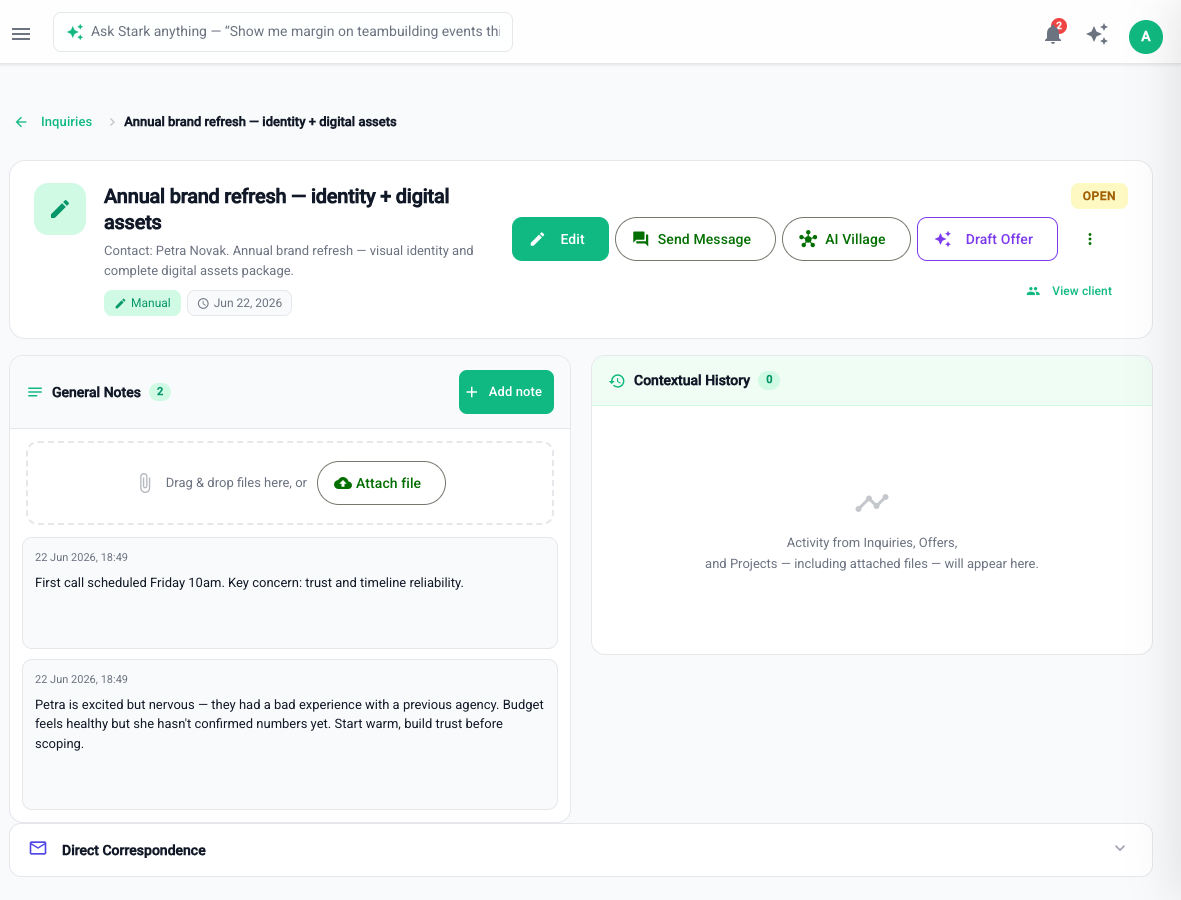
Every client relationship lives in one connected chain from first contact to final invoice, not suggested, enforced. Open any record six months from now and the full history is already there, because there was never a path to create it any other way.
- Client → Inquiry → Offer → Project → Invoice
- General Notes, never overwritten
- Contextual History, auto-assembled
- Immutable audit trail
- Automode: two-gate offer automation
- Migration Engine
The Memory
Stop rebuilding the same knowledge from scratch every time.
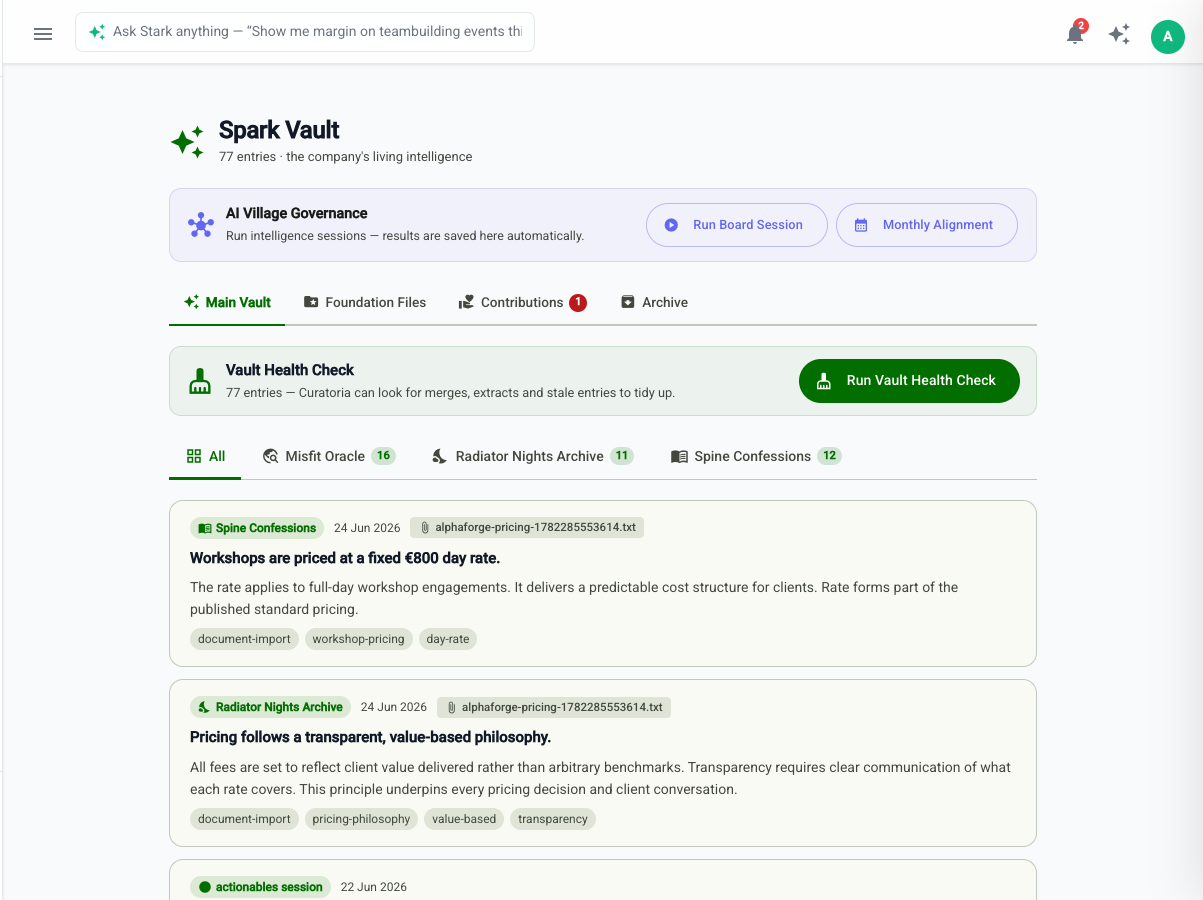
Every offer pattern, client observation, and team lesson gets captured and compounds over time. Ask Stark the same pricing question in month one versus month twelve, and the gap between a generic answer and one grounded in your own history is the whole point.
- Spark Vault (four pillars)
- Monthly Alignment
- Neo document ingestion
- Foundation Files
- Curatoria maintenance agent
- Employee Vault contributions
The Co-Pilot
Get AI that knows your business, not everyone else's.
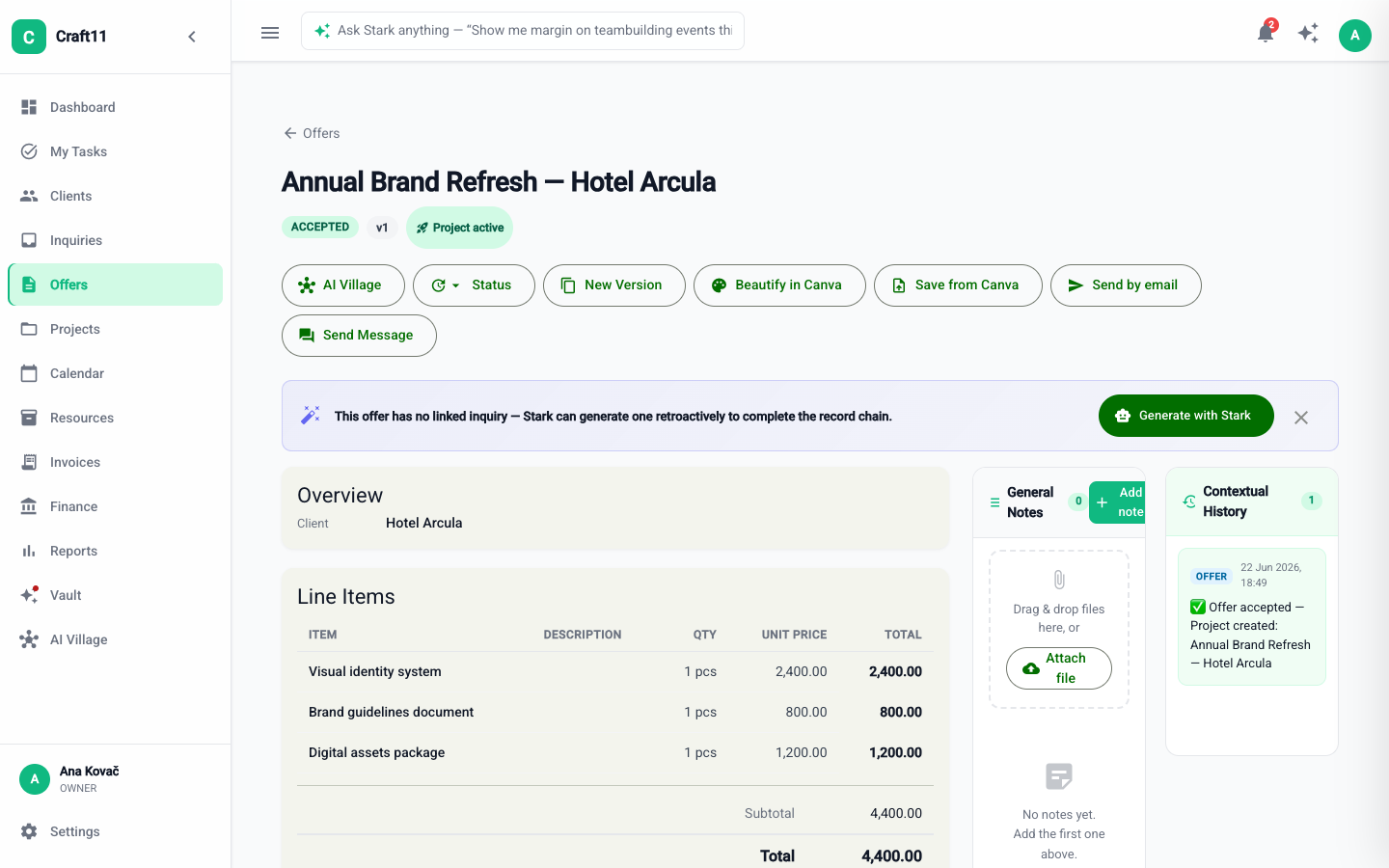
Stark sits in a glass panel beside whatever you're working on and answers from your company's actual history, not general frameworks or internet averages. Every client-facing action still waits for your explicit approval.
- Glass Stark Co-Pilot
- AI Village (15 named specialists)
- Board Sessions
- Tower Consult
- Agentic workflows with approval gates
- Voice-first via WhatsApp/SMS
The Awareness
Let the system notice what you'd otherwise miss.
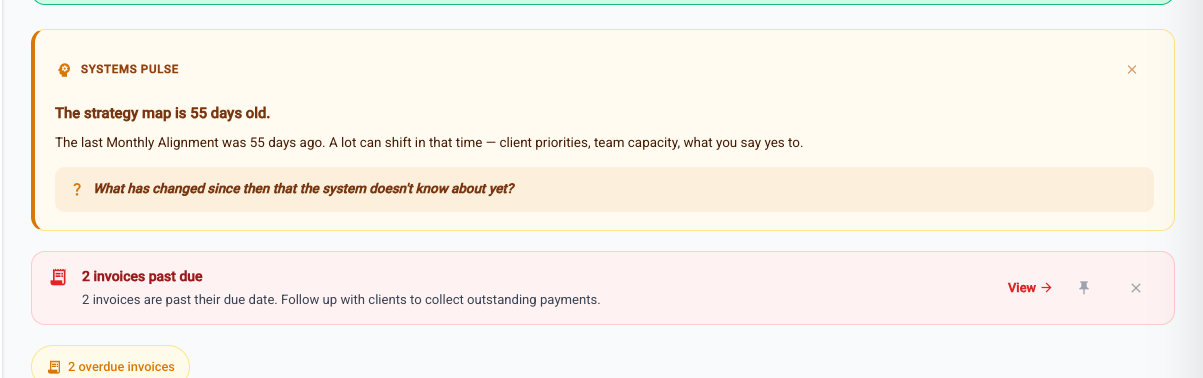
One calm observation per dashboard load when something structural needs attention: a client gone quiet, an offer sitting stale, a Monthly Alignment overdue. Nothing sounds the alarm constantly; when everything is genuinely fine, the pulse stays silent.
- Systems Pulse
- Proactive Client Intelligence
- Silent client detection
- Stale offer alerts
- Dashboard Pinning
- Action Bus
Built-in onboarding
Ask Stark anything. He'll show you around.
There's no onboarding deck. When you start, Stark already knows the product. Ask where something is, how a feature works, or to walk you through a flow, and he'll show you, step by step, right inside the app. You can even ask him to demonstrate things on your own data. Human support is available too, but most people figure it out in conversation with Stark before they ever need it.
Optional modules
Finance and Calendar: there if you want them, invisible if you don't.
The Sacred Spine and Resources (the service catalogue for your Offers) are core. Finance and Calendar are free modules you switch on per company if you want to keep everything in one place. Finance connects to your accounting software. Turn either of them off and the spine keeps working exactly as before.
15 languages
The whole app, in your language.
Every label, button, and notification — translated. Switch at any time, per user. No extra configuration.
- English
- Deutsch
- Français
- Español
- Italiano
- Português
- Nederlands
- Polski
- Čeština
- Magyar
- Română
- Slovenčina
- Slovenščina
- Hrvatski
- Srpski
Building this with early users
Ask Stark for any report. It builds it.
"How many client calls are logged in notes this month and who made them?" Stark reads the data, formats the answer, and asks if you want to export it as a PDF or monitor it monthly. If yes — it names the report, saves it to your dashboard, and runs it automatically from then on.
That includes custom visuals and charts generated from a prompt — not a dashboard you configure, but a chart Stark builds on the spot because you asked for it, exportable and saveable the same way.
This is the next thing we're building, and we're building it with Early Crew companies so the first reports Stark knows how to generate are ones real founders actually asked for, not ones we guessed they would. If you have a question you've been running manually every week, we want to hear it.
What's here already works.
Everything across the four packages above exists and runs today — not a roadmap, not a beta promise.
What's next isn't for us to guess. We're building it with the Early Crew companies actually using this every day — real requests from real usage, not a features list we assumed you'd want.
Tell us what you need →