
Mechanics, not marketing
How Craft11 actually works.
This page is written for the reader who doesn't want a feeling. They want to know what's actually enforced, what's actually stored, and what's actually true before they trust a tool with their business. No tone, no story. Just the mechanism.
The Sacred Spine
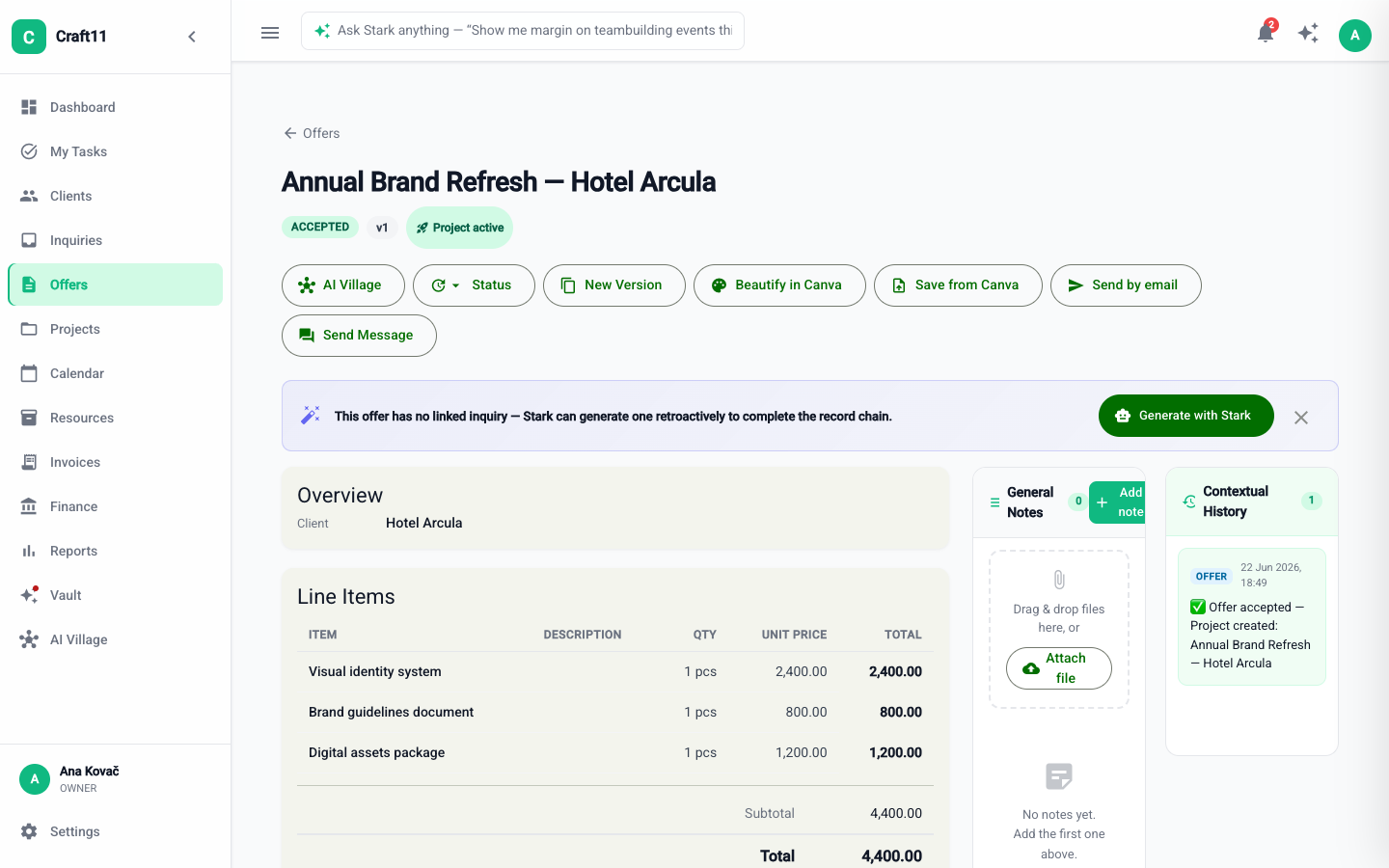
Every piece of client work in Craft11 follows one enforced sequence: Client → Inquiry → Offer → Project → Invoice. This is not a suggested workflow shown in the UI. It's enforced at the data layer. An Offer record cannot be created without a parent Inquiry. A Project cannot exist without a parent Offer. The relationship is structural, not optional, though the Inquiry doesn't have to exist first: start an Offer in a rush and Stark will backfill a basic Inquiry itself, clearly marked as AI-generated, asking permission before it does.
What this means in practice: every Project you open already has the full Inquiry and Offer history attached (the original raw note, the priced offer, every status change) because there was never a path to create a Project without that history existing first. Nothing gets disconnected because nothing was ever allowed to be created disconnected.
Finance and Calendar can be switched off per company if they're not needed. Reports can be toggled too. The spine itself cannot be disabled. It's the one part of Craft11 that isn't configurable, by design.
The Spark Vault
The Vault is a per-company memory store. It accumulates from real usage, raw notes, team observations, offer patterns, ordinary activity in between, plus the monthly Alignment where the founder formalizes pricing philosophy and team knowledge. Every AI answer in Craft11 draws on this company-specific memory as the baseline, with general knowledge enriching a specific answer only when the question calls for it, which is why the same question gets a sharper answer the longer a company uses the product.
New entries go through explicit human confirmation before they become permanent. Curatoria, the Vault's own maintenance agent, keeps it readable as it grows: curating, summarizing, archiving instead of deleting, always with approval first.
Dual Notes
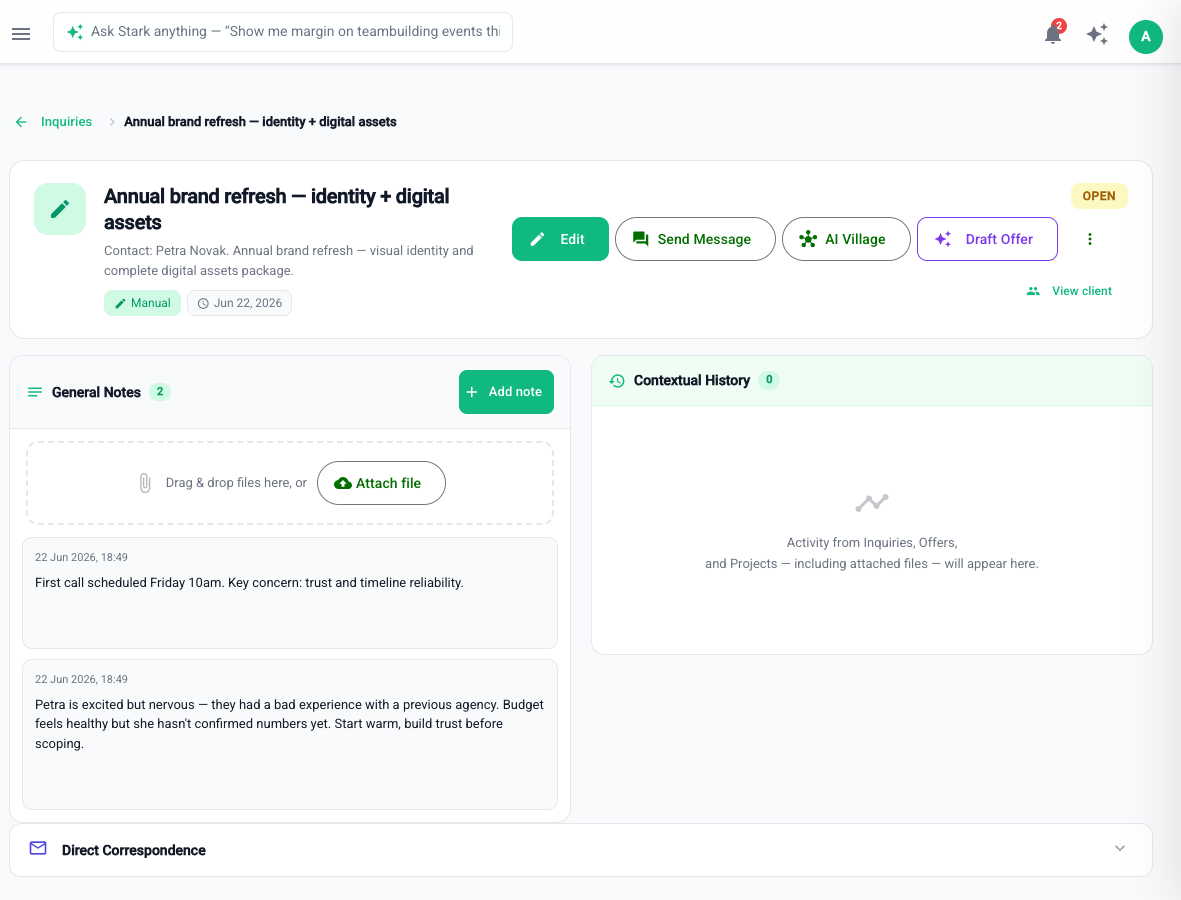
Every record has two panels. General Notes is raw text you write yourself: never edited, never summarized, never overwritten by anyone, including Stark. Contextual History is the opposite: a read-only feed of activity from that same client's linked Inquiry, Offer, and Project, assembled automatically, no one compiles it by hand.
You don't choose between writing something fast and having it organized. Both happen, on the same record, without one getting in the way of the other.
The Pluggable AI Engine
The model behind Stark isn't fixed. Craft11 ships with preset integrations for Claude by Anthropic, Grok by xAI, ChatGPT by OpenAI, and Gemini by Google, all pre-configured and ready to connect with your API key. Fully local private setups via Ollama are also supported if you need data to stay entirely on your own infrastructure, though response speeds vary significantly depending on your hardware. API credentials are encrypted at rest and never exposed in logs, exports, or to other tenants.
When any model connects, it goes through a fast entry process: it gets instructed on what it does inside the Craft11 ecosystem, how to read the Vault, what the guardrails are, and what it's expected to deliver. So regardless of which model you prefer, the system's behaviour stays consistent. The baseline doesn't shift because the engine changed. Your memory, your structure, your guardrails: all untouched.
Switching providers doesn't lose any Vault history. The model changes. The memory doesn't.
Human Approval Gates
No AI-initiated action reaches a client or commits to anything financial without an explicit human click. Automode drafts a follow-up request or a priced offer and stops, twice, waiting for approval before anything goes out. A Board Session proposal gets read, modified, or rejected by a person; it never executes on its own.
This is enforced the same way the Sacred Spine is: at the point the action would actually happen, not as a setting that could be turned off.
Questions people actually ask
What is the Sacred Spine in Craft11?
The Sacred Spine is the enforced sequence every piece of client work follows in Craft11: Client, Inquiry, Offer, Project, Invoice. An Offer cannot exist without an Inquiry, and a Project cannot exist without an Offer, though the Inquiry can be backfilled automatically by Stark if an Offer gets started first. This ordering is enforced at the data layer, not just suggested by the interface, so context can never be left disconnected.
How does the Spark Vault make Craft11's AI different from a generic chatbot?
The Spark Vault is a per-company memory layer that accumulates from real usage: offer patterns, client observations, monthly alignment sessions, team contributions. Every AI answer in Craft11 is grounded in this company-specific memory as the baseline, enriched by general knowledge only when a question specifically needs it, and gets more specific the longer a company uses the product.
Can I turn the AI off entirely and just use the spine?
Yes. Every agent and tower in the AI Village is individually toggleable, and the whole village can be switched off. The Sacred Spine keeps working on its own; it does not depend on any AI being active.
Does the AI ever act without approval?
No. No AI-initiated action reaches a client or commits to anything financial without an explicit human click. This is enforced at the point the action would happen, not as a setting that could be turned off.
Does Stark ever contact a client directly?
No. Stark drafts messages for you to review, including inside Automode, but he has no independent channel to a client. A human approves before anything sends.
That's the actual mechanism, not the pitch. The only question left is the one this page was building toward: a business running on a real spine and a memory that compounds, or one still held together by whoever remembers the most. Two years from now, which one do you want to have built?
Join Early Crew →